Process
Introduction
Designing successful products requires a balance between user-centric insights, technical feasibility, and business goals. While NDAs limit the sharing of project specifics, this page outlines a structured, evidence-based design approach that has been tested and refined across multiple products. It highlights how I navigate the complexities of product development, align with stakeholders, and ensure designs are both intuitive and operationally viable.
Step 1: Understand the Company and Stakeholders
Objective: Align with business goals and stakeholder priorities to ensure the design is both strategic and actionable.
- Collaborate with Product Management and Development to understand:
- How the company defines “success” (e.g., user satisfaction, technical scalability, revenue growth).
- Past product development cycles and pain points in the current process.
- Impact-focused development: Building scalable solutions that deliver measurable value for users and businesses.
- Map the end-to-end development lifecycle of the product.
- Identify shared and conflicting priorities.
- Document business goals and technical constraints.
Why It Matters: Establishes a shared understanding of success metrics and reduces misalignment early in the process.

Step 2: Define the User and Stakeholder Landscape
Objective: Differentiate between customers and users to ensure the product meets both business needs and user expectations.
- Customer Insights:
- Interview Product Managers or sales teams to understand how the product supports business goals.
- Identify key performance indicators (KPIs) tied to customer satisfaction (e.g., adoption rates, retention).
- User Insights:
- Engage user proxies (e.g., customer service, internal testers) to gather pain points.
- Shadow users to document task flows and user journeys, ensuring the design addresses real-world challenges.
Why It Matters: Ensures the product is built for users while aligning with business outcomes.

Step 3: Translate User Needs into Requirements
Objective: Convert qualitative insights into actionable, prioritized requirements that guide the design process.
- User Stories: Collaborate with the Product Manager to:
- Extract requirements from user journeys and task flows.
- Write user stories in human language (e.g., “As a broadcast engineer, I want to quickly configure intercom permissions to reduce setup time”).
- Validation: Review user stories with Development to ensure clarity and feasibility.
Why It Matters: Creates a shared language between design and development, reducing rework and ensuring requirements are specific, measurable, and achievable.

Step 4: Simplify the Conceptual Grammar
Objective: Reduce cognitive load by defining a clear, consistent conceptual grammar for the product.
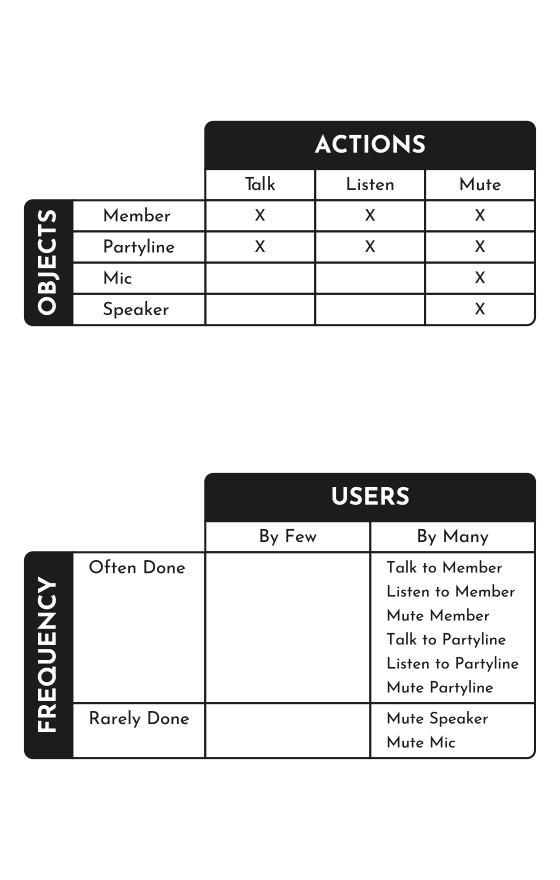
- Object/Action Matrix:
- Extract verbs, nouns, and adjectives from requirements to identify objects and actions.
- Create a matrix to map actions to objects, identifying redundancies or inconsistencies (e.g., “Copy” vs. “Duplicate”).
- Iterate for Simplicity: Merge functionally similar actions to reduce complexity (e.g., standardize “Copy” across all objects).
- Priority Matrix: Use a matrix to classify object/action pairs by:
- Frequency of use (e.g., “Often” vs. “Rare”).
- User group (e.g., “By Many” vs. “By Few”).
- Business impact (e.g., “Financial/Business” goals).
Why It Matters: Ensures the product is intuitive, efficient, and scales well cognitively with a clear hierarchy of features.
Step 5: Define the Semantic Grid and Navigation
Objective: Structure the UI with a semantic grid and navigation architecture that aligns with user behavior and technical constraints.
- Semantic Grid:
- Break the screen into zones for navigation, main content, and global/local interactions.
- Define consistent placement of elements (e.g., navigation bars, buttons).
- Navigation Architecture:
- Choose between hierarchical, matrix, or network navigation based on product complexity.
- Validate with Product Management and Development to ensure feasibility and alignment with user flows.
Why It Matters: Creates a scalable, user-friendly structure that supports both simplicity and flexibility.

Step 6: Build a Design System
Objective: Create a reusable, scalable design system that accelerates development and ensures consistency.
- Atomic Design:
- Start with tokens (e.g., color, typography), atoms (e.g., buttons), molecules (e.g., form fields), and organisms (e.g., modals).
- Define page templates and interaction rules (e.g., hover states, loading indicators).
- Collaboration: Involve Development early to ensure the system is technical feasible and maintainable.
Why It Matters: Reduces rework, ensures consistency, and speeds up future development cycles.

Step 7: Validate with Stakeholders and Users
Objective: Test early and often to identify gaps and align expectations.
- Internal Feedback: Share sketches/wireframes with Product Management and Development for input.
- User Testing: Conduct expectancy vs. actual performance tests with users to:
- Compare expected ease of tasks with actual performance.
- Identify pain points and opportunities for improvement.
Why It Matters: Ensures the design is user-centered and aligned with stakeholder expectations.

Step 8: Iterate and Refine
Objective: Use feedback to refine the design and validate assumptions.
- Iterative Process:
- Revisit earlier steps (e.g., conceptual grammar, semantic grid) if user testing reveals inconsistencies.
- Collaborate with Product Management and Development to adjust requirements or workflows.
- Continuous Validation:
- Test revised designs with stakeholders and users to confirm improvements.
Why It Matters: Ensures the final product is robust, user-friendly, and operationally viable.

Step 9: Deliver and Maintain
Objective: Ensure the design is implemented effectively and continuously improved based on real-world feedback.
- Collaborate with Development:
- Review deliverables to ensure fidelity to the design system and user needs.
- Provide ongoing feedback during implementation.
- Monitor Post-Launch:
- Use customer service logs and Product Management insights to track user behavior and identify areas for improvement.
- Integrate feedback into future design cycles.
Why It Matters: Ensures the product succeeds in the market and evolves with user needs.

Closing Thoughts
This structured approach is the result of my many years of experience in complex product development, balancing user needs, technical constraints, and business goals. By focusing on collaboration, methodology, and iteration, I ensure designs are not only visually appealing but also operationally effective and sustainable in the long term.
